Key takeaways
- Room is a dedicated theater, never used for anything else: go fixed frame (Silver Ticket, or Aeon CineGrey 3D if there is any ambient light) for the best picture-per-dollar.
- Room doubles as a living room, playroom, or guest space: go motorized (Spectrum 2 or VIVOHOME) so the screen disappears when not in use.
- Budget is the deciding factor either way: fixed frame is cheaper at every screen size than an equivalent motorized screen, because there is no motor, housing, or remote electronics to pay for.
- Picture quality is the top priority over convenience: fixed frame wins on consistency — no exceptions, no moving parts to eventually wear or mis-align.
Anyone shopping for a projector screen eventually runs into the same fork in the road: a fixed-frame screen that is simpler, flatter, and cheaper, or a motorized screen that costs more and adds a motor but disappears when the projector is not in use. Neither option is objectively better — the right choice depends almost entirely on whether the room is a dedicated theater space or has to double as something else. Here is a direct comparison using real, currently available screens on each side.
Fixed frame: Silver Ticket STR Series
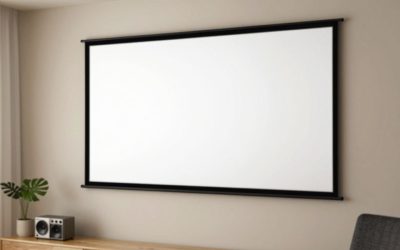
The Silver Ticket STR Series is a fixed-frame matte white screen, permanently tensioned inside a rigid frame, commonly sold in the 100 to 135 inch 16:9 range. Because the material never moves once it is mounted, it stays perfectly flat with no wrinkles or sagging over time — the single clearest advantage fixed-frame screens have, and the reason they are the most common pick in buying guides for dedicated theater rooms. The tradeoff is permanence: once it is on the wall, it is visible all the time, which only works if the room does not need to look like anything other than a theater.
Check Silver Ticket STR Series Fixed Frame Projector Screen on Amazon
Fixed frame with ambient-light rejection: Elite Screens Aeon CineGrey 3D
This is still a fixed-frame screen, but it swaps the matte white material for an ALR grey surface designed to preserve contrast in a room with some uncontrolled ambient light — a basement with a small window, or a media room that is not fully blacked out. It inherits the same flatness advantage as any fixed-frame screen, aimed specifically at the rooms where plain matte white would otherwise look washed out.
Check Elite Screens Aeon CineGrey 3D Fixed Frame Projector Screen on Amazon
Motorized: Elite Screens Spectrum 2
The Spectrum 2 is a tab-tensioned motorized screen that rolls up into a housing mounted on the ceiling or wall, controlled by remote or wall switch. Tab-tensioning pulls the material taut from both sides as it unrolls, which gets it closer to fixed-frame flatness than older drop-down screens that just hang loose — though it still involves moving parts and a motor that a fixed frame simply does not have to deal with. The entire point is that the screen vanishes into its housing when the room needs to go back to being a normal living room.
Check Elite Screens Spectrum 2 Motorized Projector Screen on Amazon
Motorized, budget-accessible: VIVOHOME Motorized Projector Screen
VIVOHOME’s motorized screen covers the same basic need — electric retraction via remote or wall switch — at a lower price point than the Elite Screens option above. It is a reasonable way to get retractable convenience without paying premium-brand pricing, with the usual tradeoff that a budget motor and tensioning system is more likely to show minor flatness imperfections than a higher-end tab-tensioned screen over time.
Check VIVOHOME Motorized Projector Screen on Amazon
Side-by-side decision guide
- Room is a dedicated theater, never used for anything else: go fixed frame (Silver Ticket, or Aeon CineGrey 3D if there is any ambient light) for the best picture-per-dollar.
- Room doubles as a living room, playroom, or guest space: go motorized (Spectrum 2 or VIVOHOME) so the screen disappears when not in use.
- Budget is the deciding factor either way: fixed frame is cheaper at every screen size than an equivalent motorized screen, because there is no motor, housing, or remote electronics to pay for.
- Picture quality is the top priority over convenience: fixed frame wins on consistency — no exceptions, no moving parts to eventually wear or mis-align.
Long-term maintenance difference
A fixed-frame screen has effectively nothing to maintain beyond occasional dusting, since there is no motor, no tensioning mechanism, and no housing to service. A motorized screen introduces a motor and tab-tensioning system that, while generally reliable across the brands covered here, is still a mechanical part with a lifespan, and a remote or wall-switch control system that can occasionally need re-pairing or a battery change. Neither issue is common enough to rule out a motorized screen for a room that genuinely needs it to retract, but it is a real tradeoff worth weighing against the convenience, not just a theoretical one.
Bottom line: do not choose based on which screen sounds more premium — a motorized screen is a convenience feature for shared rooms, not an upgrade in picture quality, and a dedicated theater room gets a better image for less money with a simple fixed frame.
Frequently asked questions
Can a motorized screen be retrofitted into a room that already has a fixed-frame screen installed?
Yes, though it typically means removing the fixed frame entirely and mounting new ceiling or wall housing for the motorized unit, since the two mounting systems are not interchangeable — it is effectively treated as a fresh installation rather than an upgrade of the existing hardware.
Do motorized screens need an electrician to install?
Most motorized screens run off a standard wall outlet with a included power adapter rather than needing a hardwired electrical connection, so a standard DIY mounting job (plus running a power cable to a nearby outlet) is typically enough without hiring an electrician.
How long do the motors in motorized screens typically last?
Tab-tensioned motors from established brands like Elite Screens are generally rated for many thousands of up-down cycles, which at normal household use (a few times per week) translates to many years of reliable service before the motor itself becomes a realistic failure point.
Write Your Review
No reviews yet. Be the first to share your experience!