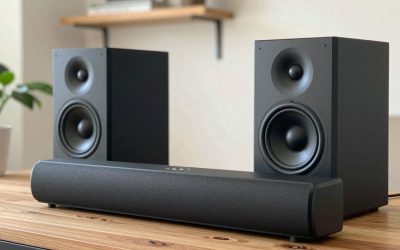
Bookshelf (standmount) speakers remain one of the best ways to get genuinely high-fidelity sound into a living room or home office without committing to full-size floor-standing towers. The category spans active, powered speakers that only need a source cable, and passive speakers that require a separate amplifier or receiver. Here are the models that keep showing up across 2025 buyer’s guides for both camps.
Edifier R1280DB
A perennial budget favorite among active bookshelf speakers, the R1280DB includes Bluetooth, optical, and RCA inputs along with a built-in amplifier, so it can connect directly to a TV, turntable, or computer without any extra gear. It is frequently cited as the best value pick for anyone building a first proper home audio setup.
Fluance Ri71
Reviewers at outlets like Rolling Stone and PopSci name the Fluance Ri71 a best-overall pick among powered bookshelf speakers, praising its balance of price and sound quality for people who want a genuinely capable stereo pair without stepping into audiophile pricing.
ELAC Debut 2.0 B6.2
On the passive side (requiring a separate receiver or amplifier), the ELAC Debut 2.0 B6.2 is commonly ranked as the best overall passive bookshelf speaker in its price class, known for a well-balanced tonal signature that works for both music and movie dialogue.
Q Acoustics 3020c
The Q Acoustics 3020c shows up repeatedly as a reference-level passive pick for music listening, with reviewers praising its soundstage and midrange clarity relative to its price point, making it a favorite recommendation for people building a two-channel music system.
Sony SS-CS5 / SS-CS5M2
Sony’s SS-CS5 line is consistently named a best-value passive entry pick, delivering a fuller low end than its size suggests thanks to a larger-than-typical woofer, which makes it a popular first upgrade from built-in TV or computer speakers.
Decide between active and passive before shopping: active speakers like the Edifier R1280DB need no extra amplifier and are simpler for a first setup, while passive options like the ELAC Debut 2.0 or Q Acoustics 3020c need a receiver but typically scale to better sound quality as you upgrade the rest of the system.
Klipsch R-51M
A favorite among passive bookshelf speakers for home theater use, the Klipsch R-51M uses the brand’s signature horn-loaded tweeter to deliver a lively, detailed high end that many reviewers describe as more exciting for movies and games than the flatter tuning of the ELAC or Q Acoustics models, at the cost of a slightly brighter overall sound signature.
Active versus passive: which to buy
Active (powered) bookshelf speakers like the Edifier R1280DB have an amplifier built into one of the speakers, so they need only a source cable — a turntable, TV, or computer — to work, which makes them the simpler and usually cheaper path to a first real stereo setup. Passive speakers like the ELAC Debut 2.0 or Klipsch R-51M need a separate stereo receiver or integrated amplifier to drive them, adding cost and complexity up front, but they let you upgrade the amplifier independently later without replacing the speakers themselves, which is the main reason serious listeners tend to graduate toward passive setups over time.
Frequently asked questions
Do bookshelf speakers need to actually sit on a shelf?
No — “bookshelf” or “standmount” just refers to the compact size class, not a requirement to place them on a literal bookshelf. Most audiophiles recommend dedicated speaker stands instead, since a shelf can introduce unwanted vibration and resonance that slightly muddies the sound compared to a stable, isolated stand.
Can I use bookshelf speakers with a TV instead of a soundbar?
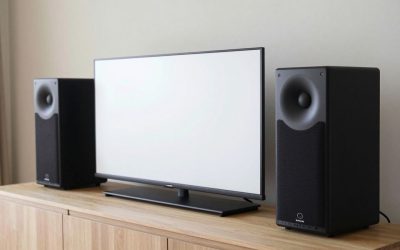
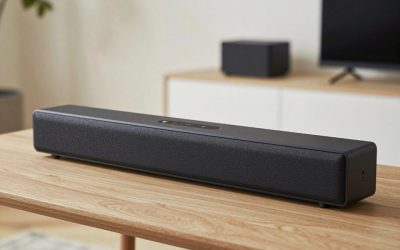
Yes, though it requires either active speakers with an optical or Bluetooth input, or passive speakers paired with a small receiver that has an HDMI ARC or optical input, which is more setup than plugging in a soundbar but generally delivers noticeably better sound quality for the same budget.
How far apart should bookshelf speakers be placed?
A common starting point is placing the speakers about as far apart as your listening position is from them, forming roughly an equilateral triangle, then angling them slightly inward toward the listening seat, which most reviewers and speaker manufacturers cite as the baseline setup before fine-tuning for a specific room.
Do I need a subwoofer alongside bookshelf speakers?
Not strictly — most bookshelf speakers, including the Klipsch R-51M and Sony SS-CS5, reproduce respectable low-end on their own thanks to a larger-than-expected internal woofer, and a subwoofer is really only necessary if you specifically want deeper home-theater bass for movies rather than balanced music listening, where an overly boomy sub can actually work against clean, accurate sound.
What is the real difference between a $100 and a $500 pair of bookshelf speakers?
At higher prices, speakers generally use better-matched drivers, more precise crossover components, and higher-quality cabinet bracing that reduces unwanted resonance, which shows up as cleaner detail and more accurate stereo imaging rather than simply louder volume; the jump from entry-level to mid-range tends to be more audible than the jump from mid-range to flagship for most listeners.
Can bookshelf speakers damage furniture or walls if placed too close?
Not physically, but proximity to a wall behind the speaker can noticeably boost bass response through reinforcement, sometimes past the point of sounding muddy, so most speaker manufacturers recommend at least a few inches of clearance from the rear wall and corners as a starting point, with dedicated stands helping maintain that spacing consistently.

Write Your Review
No reviews yet. Be the first to share your experience!